How Often Should You Wash Your House in the Pacific Northwest?
Published June 9, 2026
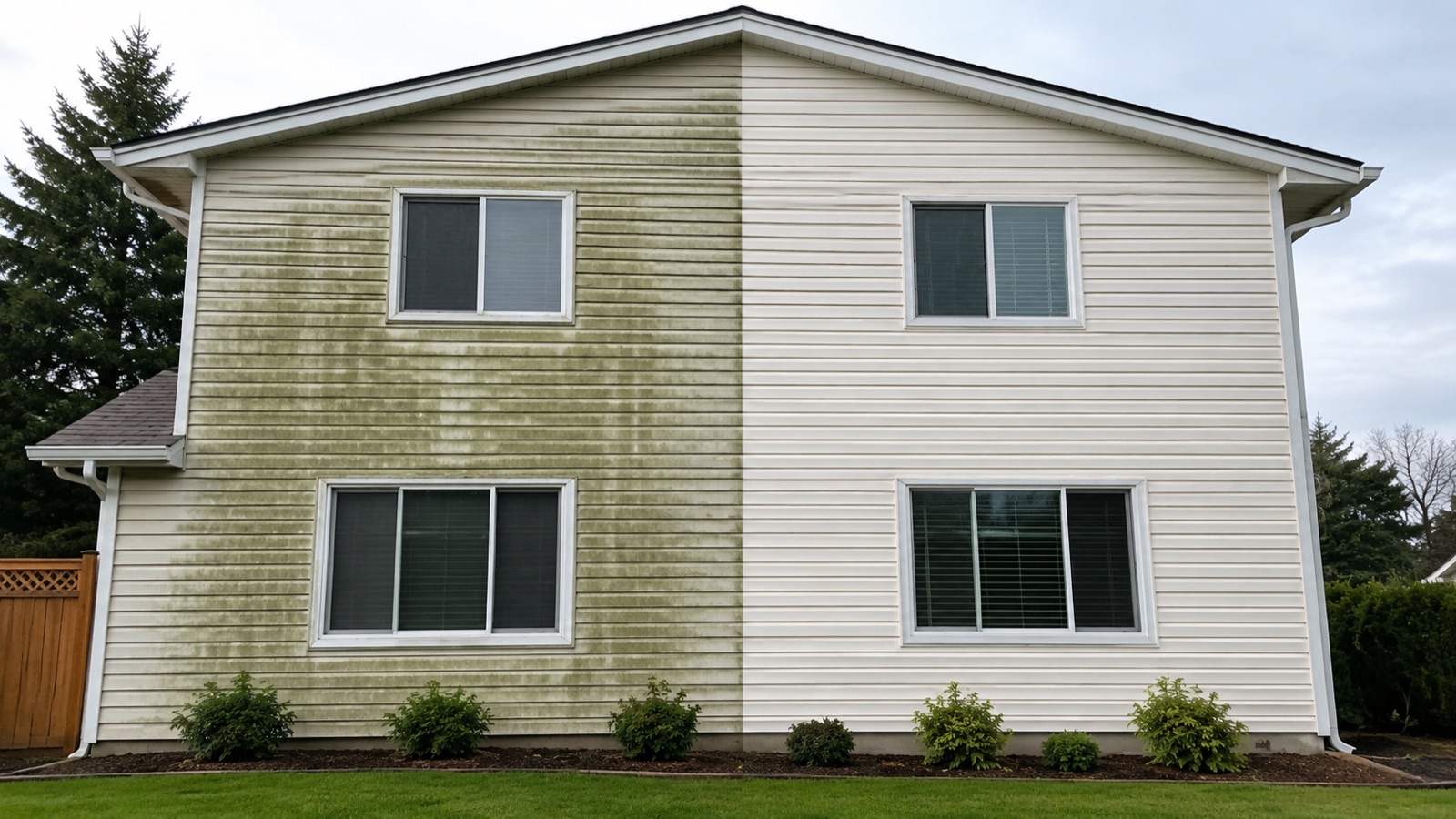
Ask ten homeowners how often a house should be washed and you'll get ten answers, most of them a flat "every year or two." That rule of thumb works fine in a dry climate. Here in the Pacific Northwest, it misses the point. What dirties our homes isn't dust settling on siding; it's living growth, moss, algae, and mildew, feeding on damp, shaded surfaces for months at a time. So the real question isn't "how many years has it been?" It's "how much biological load has your house picked up?" This guide reframes washing frequency around that idea, with a season-by-season calendar to read your own home.
Key Takeaways
- In the PNW, washing frequency should track biological load (moss, algae, mildew), not a fixed calendar.
- Most homes here benefit from a house wash roughly once a year; heavily shaded homes may want it more often.
- The wet October-to-March window is when algae and moss grow fastest, so spring is prime washing season.
- Shade, conifers, north-facing walls, and nearby greenbelts all raise your home's biological load and shorten the interval.
- House washing should be a soft wash (under 500 PSI), not high-pressure blasting, on siding, roofs, and wood.
How Often Should You Wash Your House in the Pacific Northwest?
Most Pacific Northwest homes benefit from a house wash about once a year, but the honest answer is that it depends on how fast your home grows algae and moss. A house in full sun on an open lot can go longer between washes. A house tucked under Douglas fir on a north-facing slope can look grimy again within a single wet season. The calendar is a starting point; your home's biological load is the real measure. So instead of asking "has it been a year?" walk the perimeter and ask "what's growing?"
What Is "Biological Load" and Why Does It Matter More Than a Schedule?
Biological load is simply how much living growth, algae, moss, lichen, and mildew, has colonized your home's exterior. It's the right unit of measurement here because, unlike dust or pollen, biological growth doesn't just sit on the surface waiting to be rinsed off. It's alive, it's anchored, and it keeps spreading until something kills it. Two identical houses can carry wildly different loads depending on sun, shade, and what's growing nearby.
This is why a fixed interval fails in the Northwest. A "wash every two years" rule treats a shaded home and a sunny one the same, when their growth rates aren't comparable. Reading the load instead of the calendar lets you wash when the home actually needs it, before the growth does damage.
Citation capsule: Algae, moss, and mildew on home exteriors are living organisms that anchor to surfaces and spread by spores, not surface dust that rinses away. In the Pacific Northwest's mild, wet, shaded climate they grow year-round, which makes a home's biological load a more accurate guide to washing frequency than a fixed time interval.
The PNW Biological Load Calendar
Growth in our region follows the weather, and the weather follows a predictable yearly arc. Use this seasonal calendar to anticipate when load builds and when it's best to clean.
That pattern is why spring is the busiest season for house washing here: the wet months load the home up, and the first dry stretch is when that load is both most obvious and easiest to remove.
What Raises Your Home's Biological Load?
Some homes simply grow more, faster. If several of these describe your property, treat the "once a year" baseline as a floor and plan to wash more often.
- Heavy shade and tall conifers. Douglas fir, cedar, and hemlock keep walls and roofs damp and drop organic debris that growth feeds on. Shaded homes carry the highest loads in the region.
- North- and east-facing walls. These surfaces see the least sun, dry the slowest, and almost always show algae first.
- Proximity to a greenbelt, wetland, or dense landscaping. More surrounding vegetation means more airborne spores and trapped moisture against the house.
- Poor drainage or sprinkler overspray. Anything that keeps a wall or foundation chronically wet accelerates growth.
- Existing roof moss. A mossy roof sheds spores and runoff onto the siding below, seeding the walls. (Roof moss is its own structural problem, more in our guide to moss damage and your roof.)
Don't Wait for the Calendar: Signs It's Time
Because load builds at its own pace, the most reliable schedule is the one your house tells you. Wash when you see any of these, regardless of how long it's been:
- Green, gray, or black streaking on siding, especially on shaded walls.
- A north side that looks visibly darker or "dingier" than the south side.
- Moss starting in roof seams, gutter lines, or where the roof meets a wall.
- Slick, dark patches on concrete walkways and north-facing steps (a slip hazard as much as an eyesore).
- That general "the whole house looks tired" feeling after a long wet winter.
Catching growth early is cheaper and gentler than letting it entrench, light algae rinses away with a routine soft wash, while a heavy mat has usually started doing damage of its own.
One note on scope: not every surface is on the same clock. Siding is the main event and the annual soft wash handles most homes; roofs should be inspected yearly and soft washed (never high-pressure) when moss appears; concrete can take a true pressure wash on the same spring visit. The trigger for each is its own growth, not a shared date.
Frequently Asked Questions
How often should I pressure wash my house in the Pacific Northwest?
For siding, plan on a soft wash roughly once a year, more often if your home is heavily shaded under conifers. "Pressure washing" in the literal sense isn't right for siding anyway; siding should be soft washed at low pressure. Save true pressure washing for concrete and other hard surfaces.
Is spring really the best time to wash a house here?
For most PNW homes, yes. The wet October-to-March stretch is when algae and moss grow fastest, so by spring your home carries its heaviest load of the year. A late-spring wash removes that buildup and resets the exterior before summer bakes stains in.
Can I just wash my house every couple of years like the internet says?
You can, but in our climate that interval often lets growth get established and start doing damage, especially on shaded walls and roofs. A "wash every two years" rule comes from drier regions. Here, reading your home's growth is more reliable than any fixed number.
Does washing more often damage my siding?
Not if it's done correctly. A proper soft wash uses low pressure (under 500 PSI) and the right cleaning solution, far gentler than letting algae and moss entrench. The damage risk comes from high-pressure blasting, not from regular, surface-appropriate cleaning. (It's also why your neighbor's sunnier house may grow far less moss than yours, shade and trees drive the difference.)
Read Your Home, Not the Calendar
The cleanest way to think about washing frequency in the Pacific Northwest is to stop counting years and start reading growth. Our wet, shaded climate loads homes up with algae and moss on a rhythm of its own, most visible by spring. Walk your perimeter, watch the north walls, check the roof seams, and wash when the load tells you to. For most homes that lands near once a year; for shaded properties it's more.
If you'd rather have someone read your home's surfaces for you, that's what a walkthrough is for. Cascade Clean Pros offers owner-operated, soft-wash house washing across King and Snohomish Counties, and we're glad to take a look and give you an honest, free estimate. Call or text (360) 202-7249.