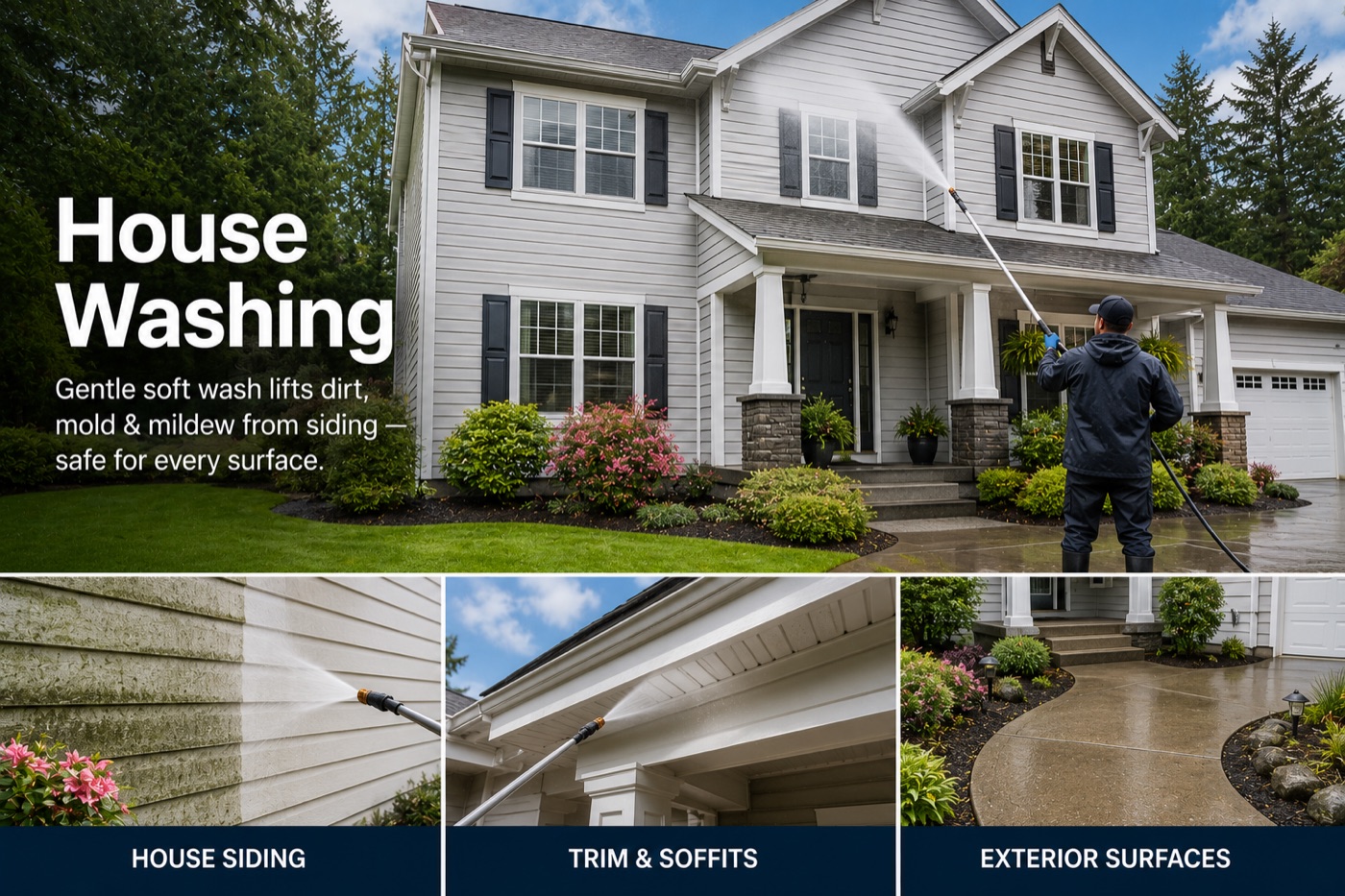
Your siding doesn't get dirty the way a car does. The grime that builds up on a Puget Sound home is mostly alive — algae, mildew, mold, and lichen that feed on the damp shade of our climate. That's why "house washing" here isn't about blasting away dirt with the highest pressure you can find. It's about choosing the gentlest method that actually kills the biological growth and lifts it off without driving water behind your siding or stripping your finish.
Cascade Clean Pros is an owner-operated exterior cleaning company serving King and Snohomish Counties — the greater Seattle–Everett corridor. We match the cleaning method to your specific siding, every time, and we'll walk the whole exterior with you during a free on-site estimate before any work starts.
Why Pacific Northwest homes grow green (and gray, and black)
West of the Cascades we get long, wet, mild stretches from roughly October through March — the exact conditions algae and moss need to colonize a north- or shade-facing wall. Add a Douglas fir or cedar canopy dropping needles and shade, gutters that keep one wall damp, and the marine air off the Sound, and you get the streaking that shows up first on the shadiest elevations.
A few patterns we see constantly in local homes:
- Green algae film on north and east walls that never get afternoon sun.
- Black or dark-gray streaking below rooflines and gutter seams, where runoff keeps the surface wet.
- Lichen and moss creeping up from the foundation, off nearby planting beds, or down from an untreated roof.
- A chalky, faded look on older painted siding that's really a layer of mildew sitting on top of oxidized paint.
None of this comes off well by simply turning up the pressure. High pressure can force water into seams and wall cavities, etch soft wood, and crack or chip aged paint — while leaving the living root structure behind to regrow in weeks.
Soft washing: the right method for most siding
For the great majority of house exteriors, the correct approach is soft washing — applying water at low pressure (generally under 500 PSI, about the force of a strong garden hose) combined with biodegradable cleaning solutions that break down the algae, mold, and mildew at the source. The solution does the work; the rinse simply carries it away.
The advantage isn't just safety. Because soft washing treats the biological growth rather than scraping the surface, the clean tends to last longer before the green creeps back. We talk through this trade-off in more detail in our guide to soft washing vs. pressure washing.
Higher-pressure washing (typically 1,500–4,000 PSI) still has its place — concrete, pavers, and some hardscape — but those surfaces are the exception, not the rule, when it comes to the walls of your home.
A surface-by-surface decision guide
The single most important question for any house wash is what is your siding made of? Here's how we approach the materials we see most across King and Snohomish County homes.
Vinyl siding
Vinyl is forgiving and very common on homes built from the 1980s onward, but it has two weak points: water can get behind it through the lap joints, and aggressive pressure can crack or warp older, sun-brittled panels. We soft wash vinyl — low pressure, the right solution dwell time, and a thorough rinse from the correct angle so we're not driving water up under the laps. The result is an even, streak-free finish without the "zebra striping" that a careless pressure wand leaves behind.
Fiber-cement (Hardie / James Hardie-style board)
Fiber-cement is durable, but the factory finish and the caulked joints are what you're protecting. High pressure can chip the painted surface and blow out caulk lines, and water forced into seams can sit against the substrate. We soft wash fiber-cement to lift mildew and algae off the painted face while leaving the coating and sealant intact. This is the method most board manufacturers point toward — low pressure and appropriate cleaning agents rather than mechanical blasting.
Cedar and wood siding
Cedar is the surface that punishes high pressure the most. Too much PSI raises the grain, gouges the soft summerwood, and can strip stain or oil unevenly — damage that's expensive and slow to undo. Cedar needs the gentlest touch: a low-pressure soft wash with a solution chosen for wood, careful dwell time, and a controlled rinse. We treat the moss and algae that hold moisture against the wood without tearing up the surface you'd then have to refinish.
Stucco and EIFS
Stucco is porous and crack-prone, and synthetic stucco (EIFS) is especially sensitive to water intrusion. Pressure aimed at stucco can blast out chips and force water into hairline cracks. We soft wash stucco at low pressure so the cleaning solution does the lifting and we're never relying on impact to remove growth.
Brick, trim, soffits, and gutters' exterior faces
Brick tolerates more, but mortar joints don't love high pressure, and the trim, soffits, and gutter faces tied into your siding are usually painted or vinyl-clad — so they get the same soft-wash treatment as the walls around them for a consistent, uniform result.
What a Cascade Clean Pros house wash includes
Every home is a little different, but a typical residential exterior wash covers:
- A walkthrough and free written estimate before we begin, so you know the scope and price up front.
- Soft washing of siding on all accessible elevations, matched to your siding type.
- Treatment of algae, mold, mildew, and light moss on the washed surfaces.
- Exterior cleaning of trim, soffits, and the outward faces of gutters where reachable.
- Careful pre-wetting and protection of plantings and landscaping near the work.
- A final rinse and a look-over with you when we're done.
We're a residential and commercial company, so whether it's a single-family home, a townhouse, or a multi-unit building, the same surface-first thinking applies.
How often should you wash your house here?
There's no single answer — it depends on tree cover, how much shade a wall gets, roof runoff, and how close you are to the water. A bright, open, south-facing wall might go a couple of years looking clean, while a shaded north wall under firs can green up within a single wet season. The honest guideline is to wash when the growth returns, and to catch it before lichen and moss get a deep hold. A free estimate is the easiest way to get a straight read on your specific home.
Don't forget the roof above the walls
A surprising amount of the streaking on siding starts higher up: moss and algae on the roof shed spores and runoff that seed the walls below. If your roof is feeding growth onto your siding, cleaning the walls alone is a short-term fix. Our roof cleaning service uses a soft-wash approach built specifically for shingles, shake, and metal — and pairing the two is often the most durable way to reset a home's exterior.
Honest, local, and owner-operated
A few things we'll always tell you straight:
- We give free, no-pressure on-site estimates — you'll get a real walkthrough, not a number guessed over the phone.
- We're owner-operated and local to the Puget Sound region, so you're dealing with the person doing the work.
- We follow up promptly on every estimate request.
- We're glad to show before-and-after photos of comparable work so you can see the method, not just hear about it.
- We match the soft-wash-first method to each surface rather than defaulting to high pressure.
If your siding is greening up on the shady side, streaking below the gutters, or just looking tired after a long wet season, we'd be glad to take a look.
House washing FAQ
Will soft washing damage my plants? We pre-wet and rinse landscaping around the work and take care with the solutions and dwell times near plantings. Tell us about any especially sensitive plants during the estimate and we'll plan around them.
Is soft washing as effective as pressure washing on siding? For algae, mold, and mildew it's more effective and longer-lasting, because it kills the growth at the source instead of just blasting the visible layer off. High pressure on siding mostly risks damage without solving the biology.
How long does a house wash last before the green comes back? It depends on shade, tree cover, and roof runoff — a sunny, open wall stays clean far longer than a north wall under firs. Because soft washing treats the growth at the root, it generally holds up better than a quick pressure rinse.
Do you wash gutters and trim too? Yes — we clean the exterior faces of gutters, plus trim and soffits, where reachable, so the finish is uniform across the whole exterior.
Can you remove existing stains or just clean the growth? We remove algae, mold, mildew, and general grime well. Deeply set stains, oxidation, or failing paint are honestly a refinishing question, not a washing one — we'll tell you straight which is which when we walk the home.
Get a free house-washing estimate: call or text (360) 202-7249, or email info@cascadecleanpros.com. We serve King and Snohomish Counties and travel farther for larger residential and commercial projects — just ask.
Where we provide house washing in King & Snohomish County
We serve homeowners and businesses across King and Snohomish Counties, including Lynnwood, Everett, Kirkland, and Mill Creek — plus Bothell, Woodinville, Kenmore, Redmond, Bellevue, Shoreline, and Seattle. For larger residential and commercial projects, we travel farther — just ask.