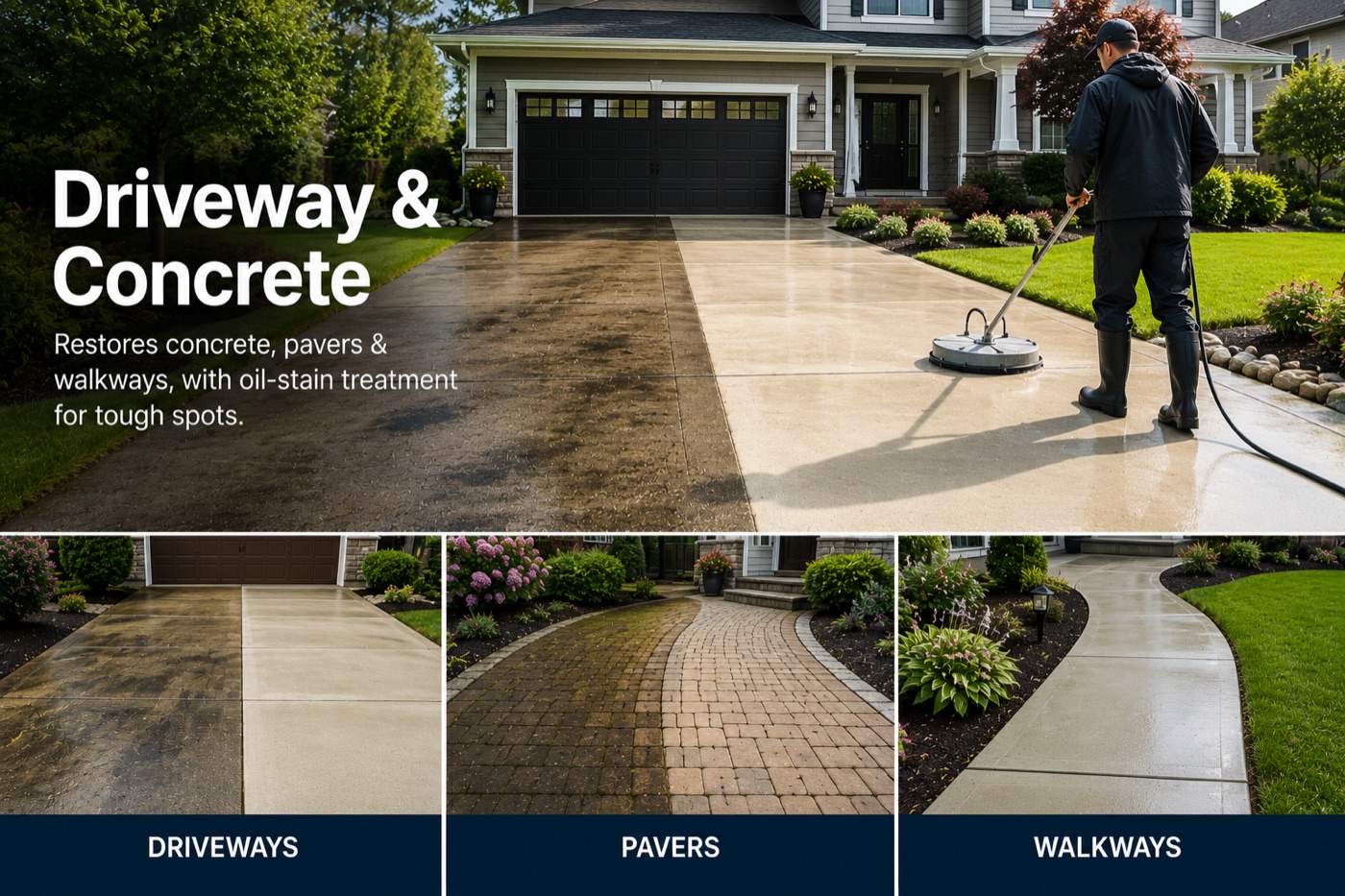
Concrete is the surface where pressure washing genuinely shines — and it's also the surface most people stop one step too early on. A clean driveway looks great the day the work is done. But bare concrete in the Pacific Northwest is a sponge: it soaks up rain, holds it, and over the wet season that trapped water is what eventually cracks, pits, and spalls the surface. The lasting fix is to clean and then seal — get the grime and growth out, then keep the water from soaking back in.
Cascade Clean Pros offers driveway and concrete cleaning across King and Snohomish Counties, and we'll talk through whether sealing makes sense for your slab during a free on-site estimate. We're owner-operated, local to the Puget Sound region, and we work on both residential driveways and commercial flatwork.
What our climate does to concrete
West of the Cascades, concrete takes a specific kind of beating:
- Constant moisture. Long wet stretches keep flatwork damp for weeks, and damp concrete grows the same black algae and green moss that colonizes everything else here — especially in shade.
- Freeze-thaw cycling. This is the quiet killer. Water seeps into the pores and hairline cracks of bare concrete, and when temperatures drop, it freezes and expands. Repeat that cycle through the winter and the expanding ice pries the surface apart from the inside — the classic flaking and spalling you see on older driveways and steps.
- Organic staining. Tannins from fir needles, leaves, and overhanging trees, plus tire marks, oil drips, and rust, all sink into open concrete pores and set.
Pressure washing handles the surface side of this — the algae, the moss, the grime, much of the staining. But washing alone leaves the concrete open and thirsty, ready to absorb the next rain. That's the case for sealing.
Cleaning: the right pressure for the surface
Unlike siding, concrete and most hardscape can take real pressure. We use pressure washing in the 1,500–4,000 PSI range appropriate to the surface, often with surface-cleaner equipment that delivers an even, stripe-free result across a driveway rather than the wand-streaking a careless job leaves behind.
What we clean:
- Driveways and garage aprons — algae, moss, tire marks, and general grime.
- Walkways, paths, and steps — including the slick, mossy treads that become a genuine slip hazard when wet.
- Patios and pool decks — broom-finish and exposed-aggregate concrete.
- Pavers — cleaned at a pressure that won't blow out the joint sand (and we can advise on re-sanding).
For surfaces that need a gentler touch — like a delicate finish, or growth right up against painted or wood surfaces — we drop to a soft-wash approach so we're not damaging anything adjacent.
This same flatwork cleaning is something we do on the commercial side too — parking areas, sidewalks, loading zones, and dumpster pads. If you manage a property, our commercial and fleet washing service covers that hardscape along with building exteriors, and follows county stormwater and water-capture practices on commercial sites.
Sealing: why the second step pays off
Once concrete is clean and fully dry, sealing is what protects the work. A good sealer does three things in our climate:
- Blocks water ingress, so freeze-thaw has far less moisture to work with — the single biggest cause of concrete surface failure here.
- Resists staining, so oil, tannins, and rust sit on top long enough to clean off instead of soaking in.
- Slows regrowth, because a sealed, less-porous surface gives moss and algae less to grab onto and stays cleaner longer.
Not every slab needs sealing, and we'll tell you honestly if yours doesn't — but for exposed driveways under trees, or newer concrete you want to protect from day one, the clean-and-seal bundle is the difference between cleaning every year and protecting for several.
Penetrating vs. topical sealers — and why it matters here
This is the part most homeowners never get explained, so here's the straight version. Concrete sealers fall into two broad families, and the difference is significant in a wet, freeze-thaw climate.
Penetrating sealers (silane / siloxane)
Silane-siloxane penetrating sealers soak into the concrete and chemically bond inside the pores, making the surface water-repellent from within while leaving it looking essentially natural — matte, not glossy. The advantages for the PNW:
- They keep their slip resistance, because they don't lay down a slick film on top — important for driveways, steps, and walkways that stay wet.
- They don't peel or flake, because there's no surface layer to fail; the protection is in the concrete, not on it.
- They breathe, letting internal moisture vapor escape rather than trapping it under a film — which matters a lot when freeze-thaw is your main threat.
For most exterior flatwork in our climate, a penetrating silane-siloxane sealer is the sensible default precisely because freeze-thaw water ingress is the problem we're solving.
Topical sealers (acrylics and film-formers)
Topical sealers form a film on top of the concrete. They can give a wet-look sheen or color enhancement that some people want on a patio or decorative surface. But the trade-offs matter outdoors here:
- They can become slippery when wet — not ideal on a sloped driveway in the rain.
- They can peel, flake, or cloud over time, especially if applied to a surface that wasn't fully dry, and reapplication means dealing with the old layer.
- A film can trap moisture in the slab, which works against you in freeze-thaw conditions.
There are good uses for topical sealers, mostly on decorative or covered surfaces. But for an open PNW driveway whose enemy is water getting in and freezing, a penetrating sealer usually does the protective job better. We'll match the recommendation to your actual surface, exposure, and what you want it to look like.
How the clean-and-seal process works
- Free on-site estimate. We look at the concrete, the staining, the exposure, and whether sealing is worth it for your slab — and put a real number to it.
- Clean. Pressure washing at the right setting to lift algae, moss, stains, and grime evenly across the surface.
- Dry. Concrete must be properly dry before sealing — sealing damp concrete is how you get a cloudy, failed finish. In our climate that means planning around the weather, which we'll factor into scheduling.
- Seal. Application of the appropriate sealer — usually a penetrating silane-siloxane for exterior flatwork — for water repellency that doesn't change the look or the grip.
- Walk it with you. A final look-over so you know exactly what was done.
Honest, local, owner-operated
- Free, no-pressure on-site estimates — including a straight answer on whether sealing is worth it for your concrete.
- Owner-operated and local to the Puget Sound region.
- Prompt follow-up on every estimate request.
- Method matched to the surface — full pressure where concrete can take it, a gentler touch where it can't.
- Happy to share before-and-after photos of comparable driveways and flatwork.
A driveway is one of the first things a visitor sees and one of the easiest surfaces to keep looking sharp for years — if you protect it after you clean it.
Driveway & concrete FAQ
Do I really need to seal, or is cleaning enough? Cleaning alone is fine for some slabs, and we'll tell you honestly if yours is one of them. But bare concrete keeps absorbing water, and in our freeze-thaw climate that trapped water is the main cause of cracking and spalling. For exposed driveways under trees, or newer concrete you want to protect, sealing is what makes the clean last.
Penetrating or topical sealer — which is better for my driveway? For most open exterior flatwork here, a penetrating silane-siloxane sealer makes more sense: it repels water from inside the concrete, keeps its slip resistance, and won't peel. Topical film sealers suit decorative or covered surfaces but can get slippery and trap moisture outdoors. We'll match the choice to your surface.
Will pressure washing damage my concrete? Sound concrete handles pressure washing well — it's one of the few surfaces built for it. Already-spalling or flaking concrete is more delicate, and we adjust accordingly. We use surface-cleaner equipment for an even, stripe-free finish rather than wand streaks.
Can you remove oil and rust stains? We lift a lot of staining, and we'll be straight about what's likely to come out versus what's set deep into the pores. Sealing afterward helps future spills sit on top long enough to clean off.
How soon after cleaning can you seal? Concrete has to be fully dry first — sealing damp concrete causes a cloudy, failed finish. In our climate that means planning around the weather, which we factor into scheduling.
Get a free driveway cleaning (and sealing) estimate: call or text (360) 202-7249, or email info@cascadecleanpros.com. We serve King and Snohomish Counties and travel farther for larger residential and commercial projects — just ask.
Where we provide driveway & concrete cleaning in King & Snohomish County
We serve homeowners and businesses across King and Snohomish Counties, including Lynnwood, Everett, Kirkland, and Mill Creek — plus Bothell, Woodinville, Kenmore, Redmond, Bellevue, Shoreline, and Seattle. For larger residential and commercial projects, we travel farther — just ask.